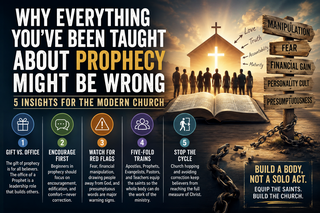
For too long, we’ve treated the prophetic like a volatile explosive—something to be feared, ignored, or handled only by a "spiritual elite." In many circles, mention of the prophetic conjures images of "weirdness" or chaotic environments where accountability goes to die. We’ve relegated prophecy to a specialized skill for the few, rather than a vital function for the many.
If we want to move beyond the noise and toward a healthy, functioning body, we have to strip away the mysticism and return to biblical structure. It’s time to stop treating the church like a spectator sport and start treating it like a training ground. Here are five essential insights that challenge the status quo of modern prophetic culture.
1. The Critical Distinction Between a Gift and an Office
There is a fundamental misunderstanding regarding the "gift" of prophecy versus the "office" of a Prophet. According to 1 Corinthians 12, spiritual gifts are distributed for the common good and are available to every believer as the Spirit leads. However, having a gift—even an incredibly accurate one—does not mean you hold the "five-fold office" described in Ephesians 4.
The gift is a tool; the office is a leadership function designed to train others. This distinction is vital for church order. Without it, we create "one-man bands" where a single individual’s accuracy becomes a substitute for healthy oversight. We must recognize that accuracy is not a replacement for office, and the office's primary job is not just to "give words," but to build a culture of maturity.
"These gifts were like our tools of the trade as a Christian... for the common good."
2. The "Encouragement Only" Rule for Beginners
When believers begin to step out in prophecy, they must operate within a specific boundary: their words should be exclusively focused on edification, exhortation, and comfort. At this level, prophecy is about building up the body and assisting in evangelizing the lost.
The reason for this "encouragement only" rule is protective. Correction is a heavyweight matter that requires the maturity and spiritual "weight" of the pastoral five-fold ministry. When untrained individuals bring "corrective" or "destructive" words without proper oversight, they often cause deep wounds in the body. By keeping beginners focused on encouragement, we ensure the environment remains safe while believers learn to discern the voice of God.
3. Spotting the "Fear Factor" and Financial Red Flags
A healthy prophetic culture is rooted in the New Covenant commandment to love one another. When prophecy is misused, it often abandons love in favor of manipulation. To protect the congregation, we must be able to spot the specific markers of unhealthy or false prophetic activity:
- The Use of Fear: Using "what if" scenarios or doom-laden predictions to manipulate people into specific actions or dependencies.
- Financial Manipulation: Using the prophetic to extract money. This includes charging for prayer or deliverance, and claiming that blessings only come if you "sell your farm and give it to me" or purchase items like "liquid water."
- Drawing Away from God: Any word that leads people away from Christ and toward a human personality or a different god.
- Presumptuousness: Claiming "thus saith the Lord" when God has not spoken.
The biblical response to a word that does not come to pass is refreshingly simple: do not be afraid of the person. You are instructed to simply ignore them.
4. The Five-Fold Ministry as a "Training Center"
The greatest misconception about Apostles, Prophets, Evangelists, Pastors, and Teachers is that they are hired to do all the "spiritual work." In reality, their primary mandate is to equip the saints to do the work of the ministry.
Imagine the five-fold as a training center where each role multiplies its own gifting:
- Prophets train others to hear God’s voice.
- Pastors equip others in the care of the flock.
- Teachers train others to handle the Word.
- Evangelists equip the body to reach the lost.
- Apostles provide oversight and "have their fingers in every pie," yet they still function within their own primary gifting.
It is crucial to note that an Apostle is not a "one-man show" who possesses all five offices; they usually have one primary gifting and still require the other four for balance. In fact, even the Apostle needs a pastor, because none of us have everything. This system of mutual accountability ensures the body attains unity and maturity, so we are no longer "children tossed around by every wind of doctrine" and human cunning.
5. The "Church Hopper" and the Growth Barrier
A significant barrier to spiritual maturity today is the "church hopper" phenomenon. When believers receive necessary pastoral correction regarding their behavior, many choose to flee to the next church rather than submit to the growth process. This cycle of avoiding correction prevents them from ever reaching the "full measure of Christ."
This dynamic presents a hard truth for leaders: "Whose people are they?"
Too often, pastors become possessive of their congregations, fearing that if they invite a visiting teacher or evangelist, they might "lose members and their offerings." This possessiveness is a form of insecurity that hinders the very growth we claim to want. A healthy leader is unafraid to invite outside voices to speak into their people, prioritizing the maturity of the body over the size of the collection plate.
Conclusion: Building a Body, Not a Solo Act
The ultimate purpose of prophecy and the five-fold ministry is the unification and maturation of the saints. When we move away from "one-man bands" and toward a model where every part of the body is equipped to work together, we create a community of righteousness and love that can actually withstand the storms of life.
As you look at your own church environment, ask yourself: Are we fostering a culture where every saint is empowered to do the work, or are we merely building a monument to a single personality? In the end, the health of the body is determined not by how well the leader performs, but by how well the saints are equipped.
Posted: 27 Jul 2026